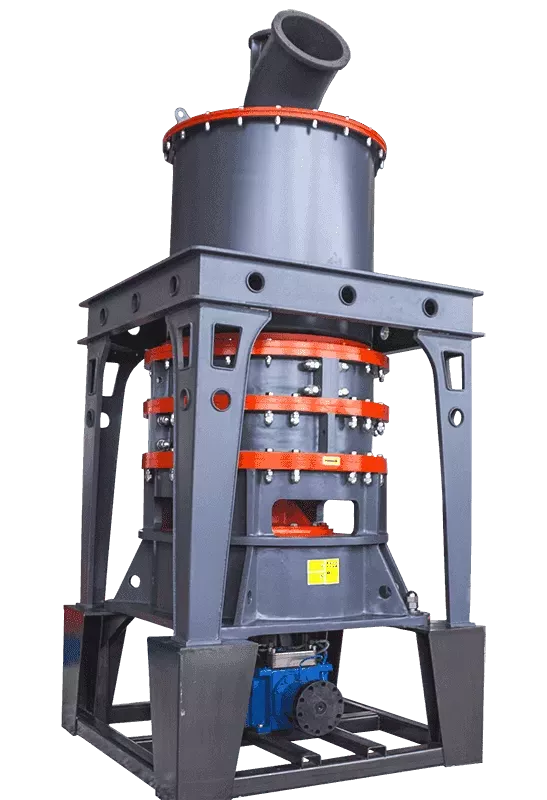
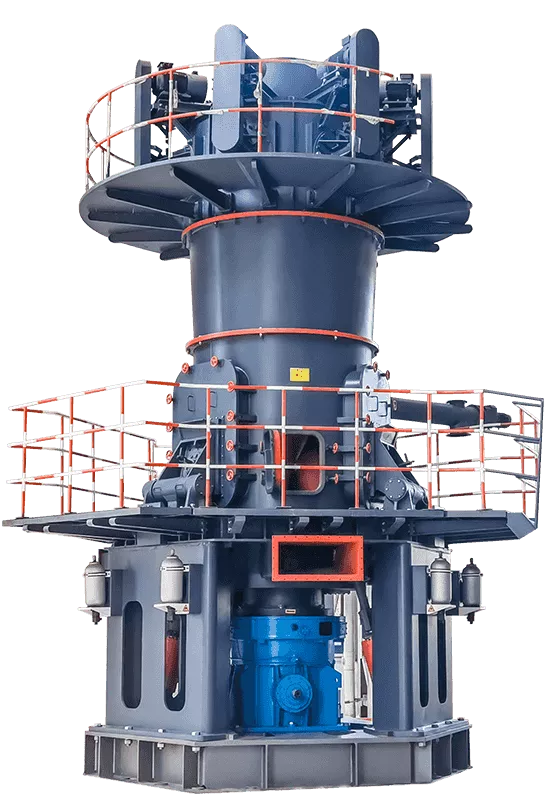
The company's main products are HGM series micro pulverizer, superfine micro pulverizer, micro pulverizer, superfine pulverizer, pulverizer and matching hammer crusher, etc.
14/08/2026 clirik
Demand for 800–2500 mesh powder in coating and paper industries highlights the all-round strengths of HGM ring roller mill in overall capacity, energy efficiency, finished powder consistency and raw material adaptability.
With objective technical deduction, we conduct quantitative comparisons between the standard HGM100L ring roller mill and a typical 4R3216 Raymond mill from four core working condition parameters.
Preface: This article adopts unified test conditions: calcite as raw material, standard dry workshop environment, raw material moisture of 2%~3%, and uniformly crushed feeding size.
Received mixed orders with various mesh specifications; the stable production range directly determines the scope of customer orders the plant can accept.
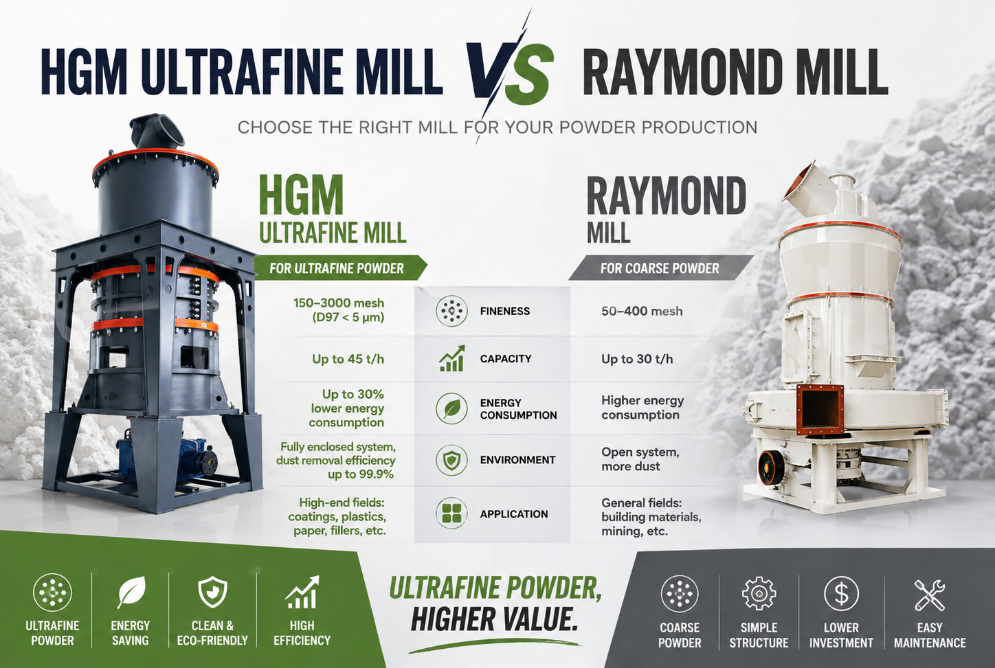
Equipped with a single-layer single-ring grinding track and simple radial blade classifier.
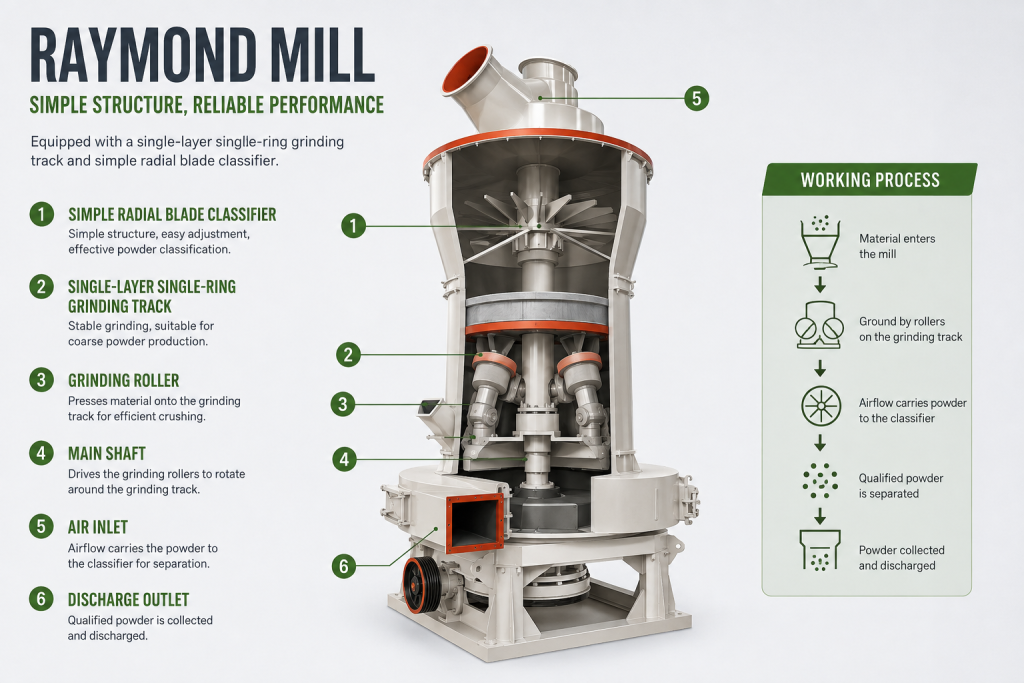
Materials only undergo one round of extrusion and shearing per circulation, leading to limited grinding times.
Meanwhile, the blade classifier features inconsistent rotational radii and an uneven centrifugal force field, allowing fine particles to escape with airflow easily.
When the target fineness exceeds 400 mesh, the recovery rate of qualified powder drops continuously.
Under 1250 mesh working conditions, the fine powder recovery rate is lower than 28%, and the machine cannot produce eligible 2500 mesh powder at all.
Adjusting the main unit or fan speed fails to solve oversize particle issues, so it can only serve low-standard orders for road base and desulfurizer filler.
Fitted with multi-layer grinding tracks and a vertical cylindrical cage classifier.
Patent documents prove the cage rotor features consistent rotation radius and uniform full-range centrifugal field to accurately cut ultra-fine particle sizes.
Materials are refined repeatedly layer by layer when falling, and optimized circulating return air duct greatly improves fine powder capture efficiency.
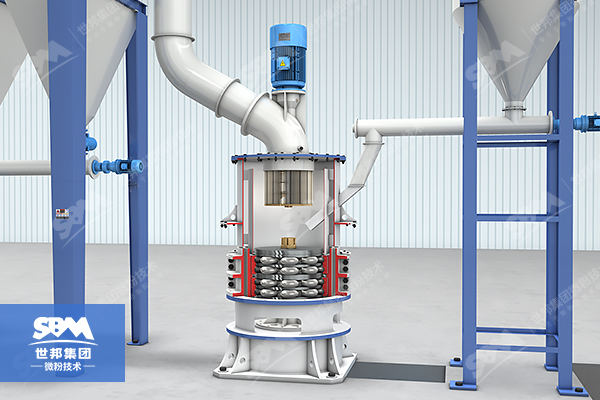
As verified by test data, the machine stably produces powder from 150 mesh to 2500 mesh.
The 1250 mesh fine powder recovery rate maintains above 85%.
One single HGM mill unit can process both low-cost ordinary filler and high-value ultra-fine powder for coating & rubber simultaneously.
It delivers far higher production flexibility without purchasing multiple separate grinders for coarse and fine powder production.
Listed below is the performance comparison table of the two grinding machines:
| Parameter Index | Traditional Raymond Mill | HGM Ring Roller Mill |
| Stable Production Mesh Range | 80~325 mesh | 150~2500 mesh |
| 1250 Mesh Fine Powder Recovery Rate | Less than 28% | Over 85% steadily |
| 2500 Mesh Production Capacity | Incapable of producing qualified finished powder | Sustainable Mass Production |
Hourly output and unit power consumption under identical fineness serve as core indicators to evaluate equipment economy.
We take 325 mesh calcite as a unified calculation benchmark, with measured data shown below:
| Parameter Index | 4R3216 Traditional Raymond Mill | Our HGM100L Ring Roller Mill |
| Total Matching Power | 79kW | 145kW |
| Standard Output 325 Mesh | 3.0~4.5t/h | 6.0~10t/h |
| Unit Power Consumption 325 Mesh | 36~42kWh/t | 18~22kWh/t |
| Unit Power Reduction Ratio | Benchmark | 47.62% Lower |
| Stable Output 1250 Mesh | No Valid Production Data | 1.5~5.5 t/h |
The total matching power of the 4R3216 Raymond mill is only 79kW, yet its single-layer grinding design results in low crushing efficiency.
The blade classifier duct creates heavy airflow resistance; most electric energy is consumed on invalid wind loss and incomplete grinding.
If the plant runs 6000 hours annually, producing 30,000 tons of 325 mesh powder will consume over 1.08 million kWh, bringing a heavy long-term electricity burden.
Although the installed power of HGM100L rises to 145kW, its multi-layer multi-roller grinding structure greatly boosts mechanical energy conversion efficiency.
Air ducts are optimised via fluid simulation to cut invalid airflow loss. Test data indicates its hourly output reaches 6–10 tons at 325 mesh, with unit power consumption only 18–22kWh/t, a 47.62% reduction compared with a Raymond mill.
The extra power input of the high-power main unit is fully offset by doubled output.
For 1250 mesh ultra-fine processing, the traditional Raymond mill has no stable production capacity, while HGM can sustain 1.5–3 tons per hour output.
No comparable rival exists in the ultra-fine powder segment in terms of energy efficiency.
Due to seasonal moisture variation, the equipment’s tolerance for feeding particle size and moisture directly determines the investment in front crushing and drying systems.
The comparison table of adaptability parameters is as follows:
| Parameter Index | 4R3216 Traditional Raymond Mill | Our HGM100L Ring Roller Mill |
| Max Allowable Feeding Size | ≤30mm | ≤20mm |
| Standard Adaptable Moisture | ≤4% | ≤3% |
| Failure Under High Moisture | Chamber Caking, Air Duct Blockage, Frequent Shutdown for Cleaning | Sealed Chamber Resists Material Adhesion |
The grinding chamber of the 4R3216 Raymond mill is semi-open. Internal rotating shovels continuously stir damp materials, easily causing accumulation and adhesion.
The industry standard applicable moisture is limited to ≤4%. Once raw material moisture exceeds the threshold, frequent blockages occur, adding extra cleaning downtime every month.
Besides, the machine reserves no standardised interface for hot air drying equipment.
To process high-humidity ore, the factory has to build an independent complete pre-drying line with high civil and equipment modification costs.
2\ HGM100L ring roller mill
The HGM100L requires feeding materials crushed below 20mm, meaning stricter control over the front crushing process.
However, its fully sealed multi-layer grinding chamber largely avoids powder retention and adhesion, with standard applicable moisture controlled within 3%.
When facing seasonal moisture fluctuation of mine raw materials, large-scale reconstruction of the whole production line is unnecessary.
HGM boasts far higher fault tolerance for various mining raw materials.
Excessive particle fluctuation leads to unqualified finished industrial products.
The comparison of classifier structure and powder precision is shown below:
| Parameter Index | Traditional Raymond Mill | Our Ring Roller Mill |
| Classifier Structure | Radial Blade Analyser | Vertical Variable-Frequency Cage Classifier |
| Fineness Adjustment Method | Stop Machine to Replace Belt Pulley | PLC Online Digital Frequency Regulation |
| D97 Deviation 325 Mesh | ±6~10μm | Within ±1μm |
| Downstream Applicable Products | Road Base, Low-Grade Filler | Coating, Plastic, Paper High-End Filler |
Particle deviation is fundamentally determined by the classifier structure.
The 4R3216 Raymond mill adopts fixed radial blade analysers.
Operators must shut down and replace pulleys to adjust mesh, only supporting segmented gear tuning without online fine-tuning.
Different radii inside the classifier create variable linear speeds, failing to fully intercept oversized particles.
Tested D97 deviation reaches ±6~10μm with broad particle distribution and excessive coarse grains, easily triggering rejection by coating and plastic buyers, resulting in dual losses of orders and logistics.
The HGM100L mill is equipped with a vertical variable-frequency cage classifier.
Operators set the target mesh digitally on the control cabinet without shutdown.
The cage maintains uniform centrifugal force across all areas to precisely intercept oversize grains.
Multi-batch tests prove its D97 deviation stays within ±1μm, delivering outstanding particle consistency across batches.
It fully meets acceptance standards of high-value fine powder and eliminates long-term economic losses caused by product returns and rework.
Comprehensive comparison of four core working condition parameters reveals that the traditional 4R3216 Raymond mill only suits low-value coarse powder below 325 mesh. It suffers inherent structural drawbacks in ultra-fine output capacity, unit energy consumption, raw material tolerance and finished powder uniformity.
Supported by patented multi-layer grinding and variable-frequency cage classifier design. HGM100L ring roller mill achieves stable production from 150 mesh to 2500 mesh, cuts unit power consumption significantly, tolerates fluctuating mining raw materials and produces consistent powder meeting high-end market standards. It is the optimal selection for new-built and upgraded ultra-fine powder production lines of non-metallic mineral processing plants.
If you have some questions about our products, please feel free to fill out the form below, and we will contact you within 24 hours.